
Marsh, river and shore
Trees Near Wetlands and Marsh in Branford, CT
Short answer
In Branford, CT, cutting or clearing trees within 100 feet of any wetland or watercourse, a stream, pond, swamp, the Branford River or the inland edge of the marshes, is written into the town's wetlands regulations as a regulated activity, so call the Inland Wetlands office at (203) 315-0675 before the work. In the tidal marsh itself and below the high tide line, the state's Department of Energy and Environmental Protection has the say; the coastal site plan review that zoning uses comes into play only with a zoning or subdivision filing.
One independent local contractor can plan the tree work once the office has said what is allowed, and fit the method to soft ground near the water.
What does Branford's 100-foot rule say?
The town's Inland Wetlands and Watercourses Regulations, effective Aug 12, 2022, define a regulated activity as any operation in a wetland or watercourse that removes or deposits material, obstructs, alters or pollutes it. Then they go further. Section 2.1(qq)(1) says that "clearing, cutting, alteration, damaging of vegetation (living or dead)," along with grubbing, filling, grading, paving and excavating, "on land within100 feet measured horizontally from the boundary of any wetland or watercourse is a regulated activity" (Branford Inland Wetlands and Watercourses Regulations, checked Nov 28, 2026; the missing space is in the original).
Two more pieces of that section matter for trees:
- Sec. 2.1(qq)(3): "The Agency may extend the upland review to the top of slope, if steep slopes or erodible soils are present." On a steep bank above the river or a ravine, the reach can be more than 100 feet.
- Sec. 2.1(qq)(4): the Agency may rule that any activity in the review area, or elsewhere, is likely to affect wetlands and is regulated.
The regulations count dead vegetation too, so a dead tree near a stream is not automatically exempt.
Is ordinary yard work near water allowed?
Some is, but the Agency decides. Section 4.1(c) allows, as of right, "Uses incidental to the enjoyment or maintenance of residential property" on lots no bigger than the largest minimum house lot in town that have a house on them, and says those uses "shall include maintenance of existing structures and landscaping," but not removing or depositing "substantial amounts of material" in a wetland or watercourse, or diverting or altering one. Section 4.2 adds that "The Agency shall make the determination as to whether a proposed activity meets the definition that it is a non-regulated use or is a regulated activity." In plain terms: mowing and pruning the lawn trees you already have may be fine, clearing a wooded strip along the brook is a different thing, and the office tells you which one your job is.
Who to call: Inland Wetlands and Natural Resources Department, Town Hall, 1019 Main Street, Branford, CT 06405; (203) 315-0675; inlandwetlands@branford-ct.gov (front page of the regulations, checked Nov 28, 2026). Describe the tree, how far it is from the water, and how it would come down and be hauled out.
Where are the wetlands in Branford?
More places than the obvious marshes. Wetlands are mapped by their soils, so a wet strip with no standing water can still count. In Branford that includes the salt marsh edges along the Branford River, Stony Creek and Short Beach, the swamps and pond edges inland, and the strips along brooks behind house lots. The Branford Land Trust's inventory notes that the town's mucks and peats lie "along the coastal marshes and swamps associated with river and ponds" and are always subject to wetland regulations (Branford Land Trust, Natural Resources Inventory, checked Nov 28, 2026). If you aren't sure, the wetlands office has maps, and a soil scientist can flag the boundary.
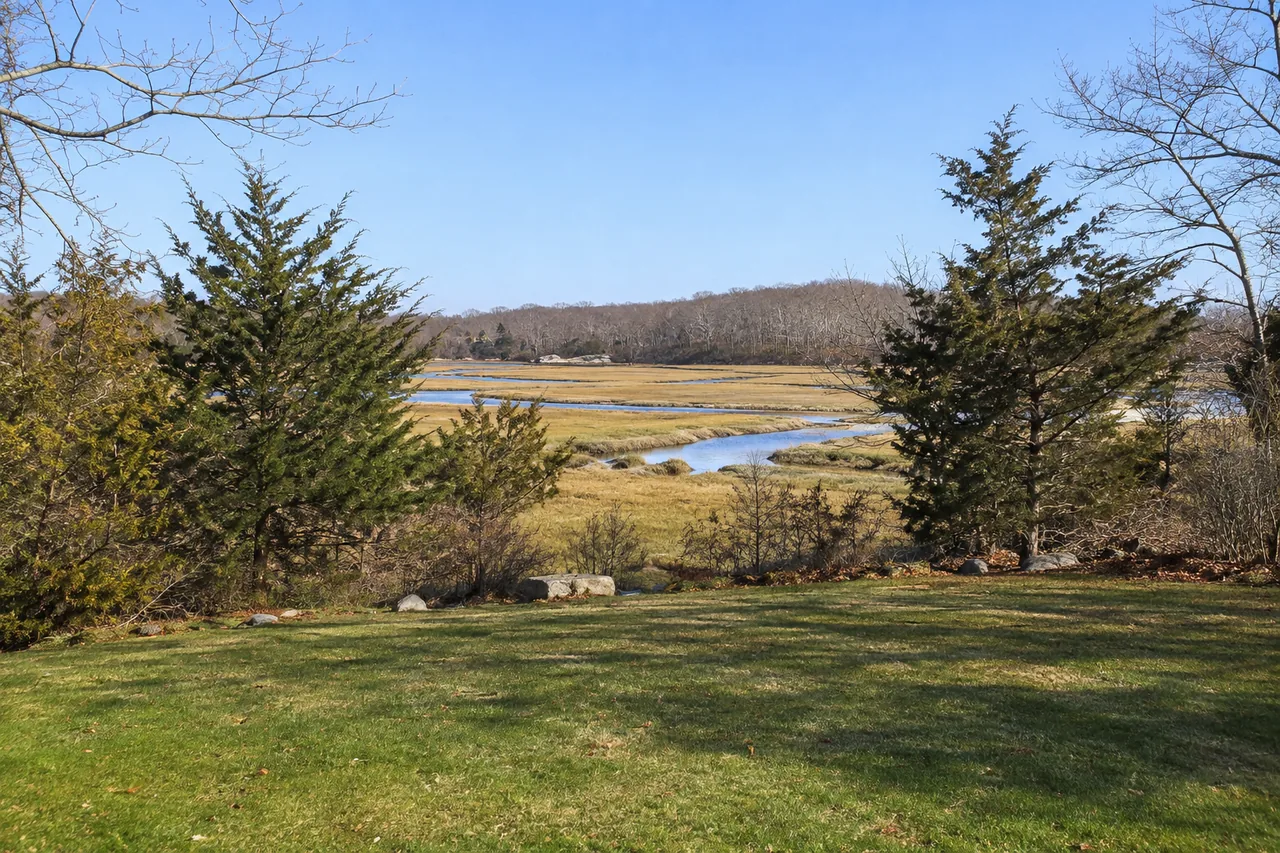
What about the tidal marsh and the shore?
That is the state's. DEEP's coastal permitting guidance says any work in tidal wetlands or waterward of the coastal jurisdiction line without proper authorization violates state law, and lists among regulated work "the removal of vegetation or other material, or other modification of a site, waterward of the high tide line" (CT DEEP, Coastal Permitting FAQ, checked Nov 28, 2026). DEEP's list says it is not complete, so a tree or shrub actually in the marsh, or on the seaward side of a seawall, needs a call to DEEP's Land and Water Resources Division before it is touched.
The marsh soils show why. Westbrook soils, the series mapped in Connecticut's tidal marshes, are organic peat over loam, "subject to tidal flooding twice daily except in areas protected by embankments and tide gates," and strongly salty (USDA, Westbrook series, revised June 2025, checked Nov 28, 2026). Equipment sinks there, and the trees and shrubs at the marsh edge root shallowly in wet ground.
Does the coastal boundary affect a tree job?
Usually not on its own. Connecticut's coastal boundary reaches inland at least 1,000 feet from mean high water, or farther where the 100-year coastal flood zone or 1,000 feet from tidal wetlands reaches farther (CGS 22a-94(b), checked Nov 28, 2026), so much of shoreline Branford is inside it. But coastal site plan review attaches to applications filed with zoning and planning: site plans, subdivisions, special permits and variances (CGS 22a-105 and 22a-109). Branford's coastal form is a supplement filed with a zoning or subdivision application at the Planning and Zoning Commission, (203) 488-1255 (Branford CAM form). Taking down a yard tree isn't such an application. Clearing that is part of a new house, an addition or a subdivision is, and the state lets towns exempt a single-family house from the review except within 100 feet of tidal wetlands, coastal bluffs, beaches or dunes (CGS 22a-109(b)).
Why does Route 146 matter for shoreline trees?
It runs right along the marshes. UConn's Resilient Connecticut project describes many points on the road at or below 10 feet of elevation, most as low as 5 to 6 feet, with Amtrak underpasses that flood (Branford Route 146 fact sheet, 2019). Trees along the route are the state's, the road is a State Scenic Road, and cutting there without the state's permission can bring a Branford citation (scenic road rules).
Do salt water and flooding kill shoreline trees?
They can. Storm surge pushes salt water over lawns and into root zones; Sandy flooded an intersection in Indian Neck and the Meadow Road substation in Short Beach, and Beckett Avenue was underwater in both Sandy and Irene (New Haven Independent, 2012). A tree that doesn't tolerate salt may brown and decline over the next season or two after a surge. Give a tree a season before deciding, unless it is clearly dead or dangerous.
How is tree work done near wetlands?
- Pieces get lowered by rope and carried out, rather than dropped into the wet area.
- Trucks and chippers stay on the driveway or road; mats may go down on soft lawn.
- Stumps are often cut flush and left, because grinding near water is soil disturbance.
- Brush and chips go out, not into the marsh or stream.
Whatever the wetlands office allows becomes part of the plan. Put it in the written agreement.
Wetlands questions people ask
A dead tree near my stream could hit the house. Do I still need to ask?
Call the office first and explain the danger. The regulations count dead vegetation, and the Agency decides what is regulated. An emergency is a reason to call quickly, not a reason to skip the call.
How do I know if I'm within 100 feet?
Measure from the wetland boundary, which isn't always where the water is. If you aren't sure where the boundary is, the office can help, and a soil scientist can flag it.
Does North Branford have the same rule?
North Branford has its own Conservation and Inland Wetlands and Watercourses Agency with its own regulations. Ask that town's office; don't assume Branford's distances apply.