
Ground and trees
Branford, CT Soils and the Trees on Them
Short answer
Branford, CT trees grow on four kinds of ground: thin, stony glacial till over granite and gneiss ledge across much of the middle and east of town, deep sandy and gravelly outwash on the old glacial plains, basalt, shale and sandstone to the northwest, and salt marsh peat along the shore. Thin soil over rock is the one that matters most for tree work, because roots spread wide and shallow there, trees tip over with a slab of stones in their roots, and stump grinders hit rock.
One independent local contractor plans removals, stump grinding and truck access around the ground on each lot.
What rock is under Branford?
The Branford Land Trust's natural resources inventory describes the central and eastern parts of town as mostly gneiss and granite, including the Stony Creek granite, quarried in Branford and used in buildings and monuments far beyond Connecticut; the northwest as mainly basalt and shale, with sandstones and other rocks; and trap rock, formed from lava, mined in the area at places such as Beacon Hill (Branford Land Trust, Natural Resources Inventory, ch. 2, checked Nov 28, 2026). The Stony Creek stone is an unusual pink granite; ConnecticutHistory.org lists the George Washington Bridge and Grant's Tomb among the works that used granite from the Stony Creek area (ConnecticutHistory.org, checked Nov 28, 2026).
The ice sheet that covered New England scraped much of that rock bare. The inventory notes that many areas of Branford were scraped clean of their soils, with bedrock still exposed in places, and that glacial erratics and till were quarried for road beds and foundations.
What is it like where the soil is thin?
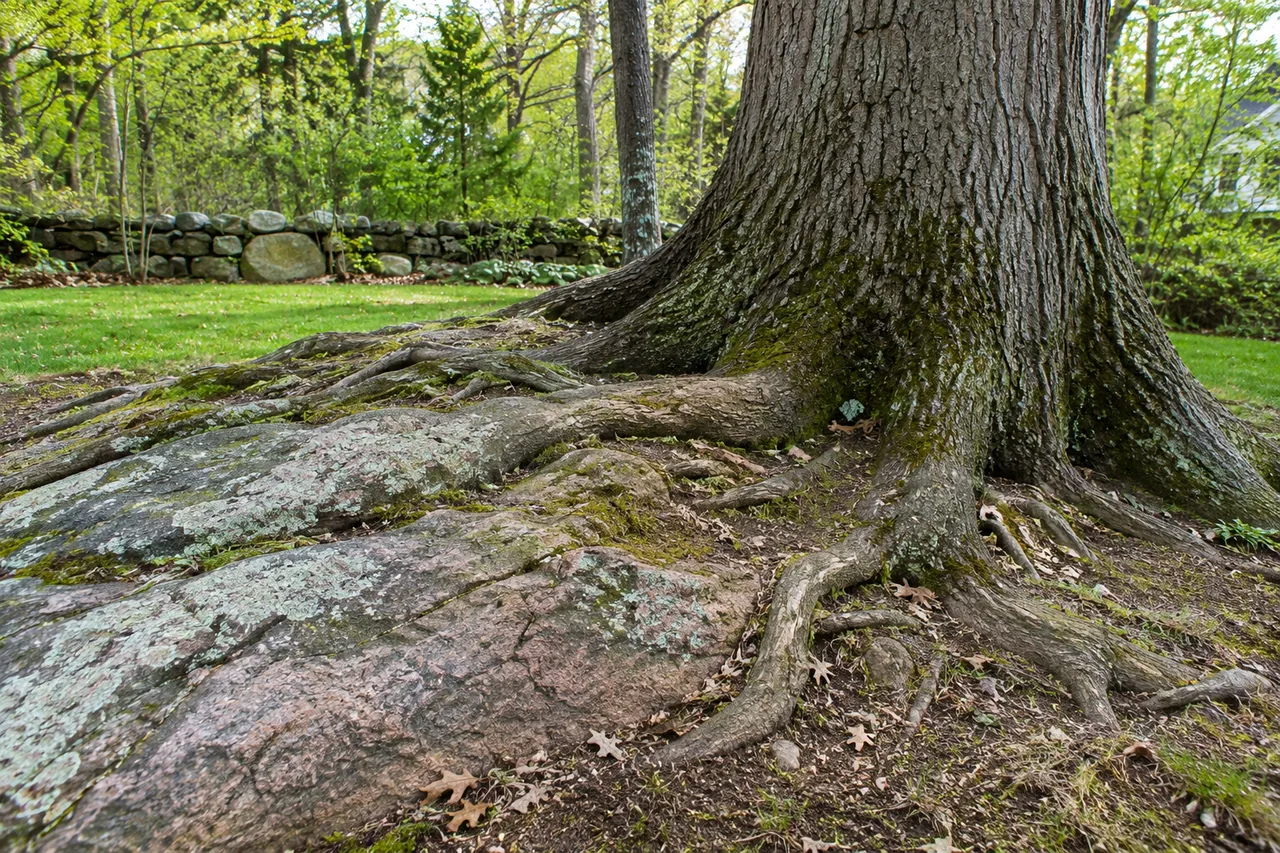
Stony and shallow. The federal soil survey's Hollis series describes it: soil formed in "a thin mantle of till derived from local bedrock of schist, granite, and gneiss," with hard bedrock 25 to 50 centimeters down, about 10 to 20 inches, well to somewhat excessively drained, and mostly forested in oaks, hickory, white pine, hemlock and birch (USDA, Hollis series, revised May 2016, checked Nov 28, 2026). The inventory also names Holyoke soils in the shallower areas.
For trees, that means:
- Wide, shallow roots. A big oak on a foot of soil over ledge spreads its roots across the surface and into cracks in the rock. That plate is what holds it up.
- Uprooting in storms. When the soil is soaked and the wind gets up, the root plate levers up in one piece, carrying soil and stones and leaving a shallow, wide hole.
- Drought stress. Shallow soil dries out fast. The 2015-2016 drought, and the spongy moth outbreak that followed, hit trees on thin soil hard.
- Root damage from work. Trenching, regrading or a new driveway on thin soil can cut a large share of a tree's roots, because they are all near the surface.
And where the soil is deep and sandy?
On the glacial outwash plains and terraces, the inventory names Branford-Manchester soils on slopes of 0 to 8 percent. The Branford series, whose described sample pit is in the town of Branford, is "very deep, well drained," formed in loamy material over sandy and gravelly outwash derived mainly from red sedimentary rocks and basalt; common trees on it are several oaks, hickory and white pine, and much of it was farmed (USDA, Branford series, revised January 2005, checked Nov 28, 2026). Here stump grinding goes faster, trucks find firmer ground, and roots go deeper, though sandy soil also dries quickly in a drought.
What grows on the marsh edge?
Marsh grasses, then shrubs and a fringe of trees where the ground rises. Westbrook soils, mapped in Connecticut's tidal marshes, are very deep, very poorly drained peat over loamy material, "subject to tidal flooding twice daily except in areas protected by embankments and tide gates," and strongly saline, with salt meadow grass, spike grass and blackgrass among the common plants (USDA, Westbrook series, revised June 2025, checked Nov 28, 2026). The inventory says mucks and peats along the coastal marshes and swamps are always subject to wetland regulations. Before cutting near them, see the wetlands page.
What about downtown and along Route 1?
Much of it is fill and graded ground. The inventory describes large sections of udorthents, soils disturbed by building, concentrated downtown and along Route 1 and I-95, and notes that these urban soils no longer support woodland. Street and yard trees there often have compacted soil, buried roots and little room, and decline sooner.
How does each kind of ground change tree work?
| Ground | Roots | Removal and stumps |
|---|---|---|
| Thin till over granite and gneiss ledge (Hollis-type) | Wide and shallow, into rock cracks | Outriggers may land on rock; grinding stops at ledge; stones break grinder teeth |
| Deep sandy outwash (Branford-type) | Deeper, well drained | Firm access; grinding is quick; roots run deep |
| Basalt and shale in the northwest | Varies with depth to rock | Ridge-top trees catch wind; rock near the surface |
| Salt marsh peat (Westbrook-type) | Shallow, in wet ground | Soft ground; state and town wetland rules apply |
| Fill and graded ground downtown | Restricted, often compacted | Buried debris; utilities close by |
Soil questions people ask
Why did my tree fall over instead of snapping?
On thin, soaked soil over rock, the root plate often gives before the trunk does. A pulled-up plate with stones and soil in it, and a matching hole, is the usual sign.
Can a stump on ledge be ground out?
Down to the rock, yes. Below that, no. The grinder can level it, and the roots spread across the rock will rot over the years.
How do I find out what soil my lot has?
The USDA's Web Soil Survey maps soils by address. The town's wetlands office can also tell you whether wetland soils are mapped on or near your lot.