
Pests and disease
Dying Oaks, Beech and Ash in Branford, CT
Short answer
Trees are dying around Branford, CT mostly from four state-tracked problems: oaks weakened by the spongy moth outbreak that followed the 2015-2016 drought, beech leaf disease (found in Connecticut in 2019), emerald ash borer (first found in Prospect in 2012), and hemlock woolly adelgid. Dead ash and oak turn brittle and dangerous within a few years, so a dying tree near a house, a driveway or the road should be looked at soon.
One independent local contractor can tell you whether the tree is dead, dying or just stressed, and take it down or prune it out if it needs to go.
What killed so many oaks?
A drought and a caterpillar, then everything that follows a weak tree. CT DEEP says the dry springs of 2015 and 2016 kept the fungus that normally kills spongy moth caterpillars from building up, which set off a multi-year outbreak with extensive defoliation in eastern Connecticut. Significant oak mortality continued into 2018, and into 2019 and 2020 as the two-lined chestnut borer and armillaria root rot finished off weakened trees (CT DEEP, The Spongy Moth in Connecticut, checked Nov 28, 2026). The insect was called the gypsy moth until its common name was changed.
DEEP places the heaviest defoliation of that outbreak in eastern Connecticut, but oaks are the backbone of Branford's woods and yards, and the same pests are here. A UConn Extension forester's 2018 survey of dead roadside trees in eastern and southern Connecticut found an average of 14 dead trees per mile of sampled road, half of them a high risk, and warned that dead oaks start dropping branches soon and the trunks may stand three to five years before the roots rot and they fall (UConn, Tree Mortality in CT, 2018). The same report estimated removal at $500 to $1,000 a tree.
How do I tell if an oak is dying?
- A thin crown with dead branch tips at the top, or leaves that come out small and sparse in spring.
- Bark loosening or falling off in sheets, or woodpeckers working the trunk.
- Mushrooms or honey-colored fungus at the base, a sign of root rot.
- No leaves at all by June on part or all of the tree.
What is beech leaf disease?
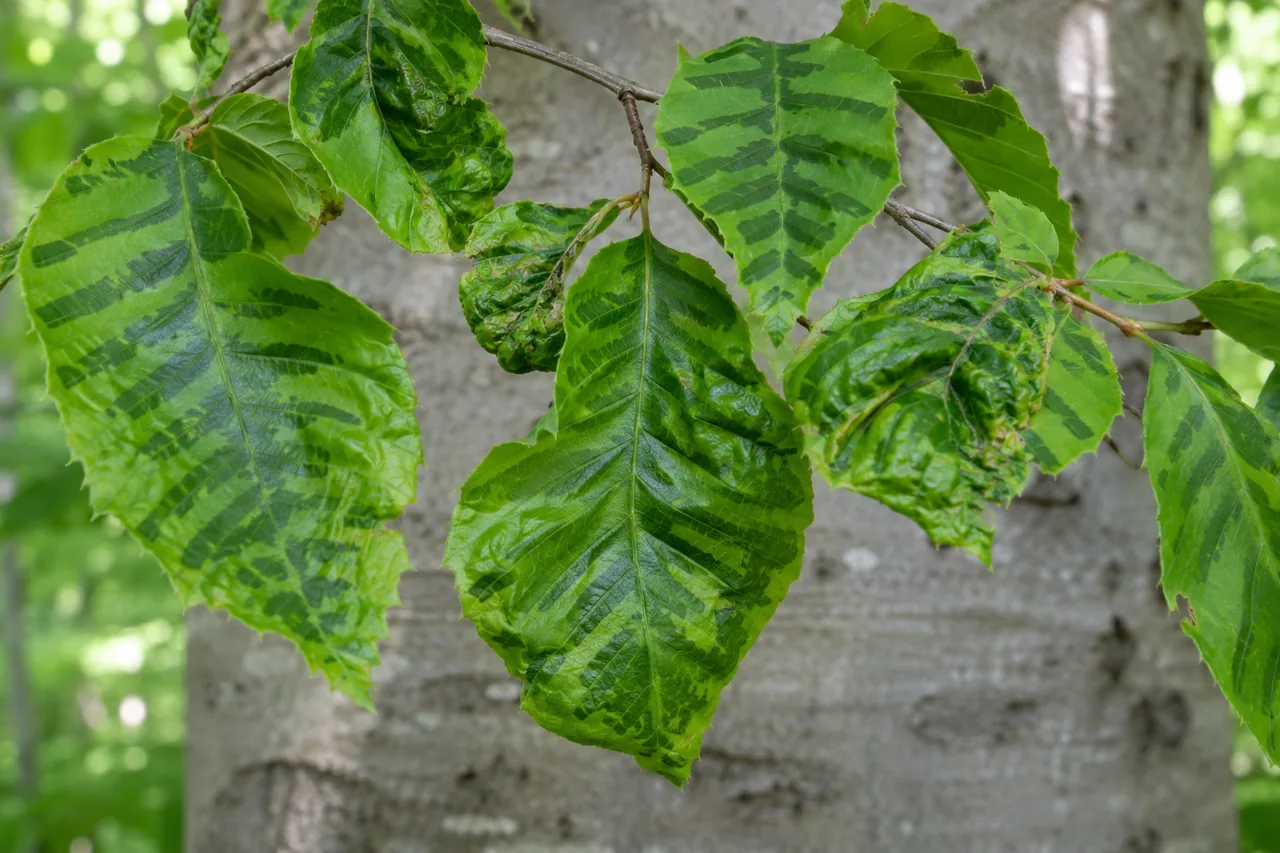
A disease caused by a microscopic roundworm, the nematode Litylenchus crenatae mccannii, living in beech leaves and buds. It was first identified in Ohio in 2012, reached Connecticut in 2019, and is now widespread in the state (CT DEEP, Beech Leaf Disease, updated August 2026, checked Nov 28, 2026).
- Signs: dark stripes between the side veins of the leaves, easiest to see as buds open in spring; badly affected leaves are shrunken, crinkled, thick and leathery; leaves thin out in the lower crown, drop early, and buds fail.
- How fast: DEEP says saplings die in 1 to 5 years and mature trees in 6 to 10 years, and that mortality can top 90 percent for young trees.
- Treatment: no cure. Phosphite treatments have protected individual trees in small trials.
How fast does emerald ash borer kill an ash?
Fast. Connecticut became the 16th state with the beetle in 2012, when it was found in Prospect, in New Haven County, and it has since spread throughout the state. DEEP says infested trees often die within two to three years, and whole stands within eight years of the beetle arriving (CT DEEP, Emerald Ash Borer, updated September 2026, checked Nov 28, 2026). The state's quarantine on moving ash wood ran from 2014 until it was lifted in 2021; rules on moving firewood still apply.
- Signs: a D-shaped exit hole in the bark, which no other ash borer makes; S-shaped tunnels under the bark; woodpeckers stripping patches of bark; thinning in the upper crown; and bunches of shoots sprouting low on the trunk.
- Options: insecticide treatment has kept individual ash trees alive. A tree already losing much of its crown is usually past saving.
- Why not wait: dead ash dries and gets brittle, which makes climbing it dangerous and can turn a rope job into a bucket-truck or crane job.
What is happening to the hemlocks?
Hemlock woolly adelgid, a tiny sap-sucking insect, was first reported to the Connecticut Agricultural Experiment Station in New Haven in 1985 and was found throughout the state by 1997. Look for small clusters of white, waxy wool on the underside of the needles, best seen from March through May; affected trees drop needles, show twig dieback and thin out. DEEP says death can come within four years, often with help from the elongate hemlock scale, in the state since the 1970s (CT DEEP, Hemlock Woolly Adelgid, updated May 2026, checked Nov 28, 2026). Horticultural oil or insecticidal soap, once or twice a year in May and late June, is the preferred control for single trees.
What else is on the state's watch list?
DEEP's list of threats to Connecticut trees also names oak wilt, southern pine beetle, Asian longhorned beetle and spotted lanternfly (CT DEEP, Threats to CT Tree and Forest Health, updated Sept 24, 2026). If you see something unusual, the state entomologist at the Agricultural Experiment Station takes questions at CAES.StateEntomologist@ct.gov (listed on DEEP's emerald ash borer page).
Can salt and storms kill a tree slowly?
Yes. On the shore, a storm surge that floods a yard with salt water can brown leaves and kill roots, and the damage may not show until the next season. Roots torn in a windstorm, or a lawn regraded over a root zone, can also lead to slow decline. Give a stressed tree a growing season unless it is plainly dead or dangerous.
If the dying tree is in the road, who handles it?
The Tree Warden. Branford's ordinance lets the Tree Warden order a town tree removed or pruned for public safety at the town's expense, and, with the Selectmen's approval, remove plants that host pests (Branford Tree Ordinance). CT DEEP also asks people to report declining ash that may endanger people or buildings to the town tree warden for town trees, or to the Department of Transportation for trees along state highways. For a tree on your own land, the decision and the cost are yours.
Questions about sick trees
My oak leafed out late and thin. Is it dying?
Not necessarily. A late frost, drought or a heavy caterpillar year can thin a crown for a season. Dead branch tips at the top, loose bark and fungus at the base are worse signs. Have it looked at if it could hit something.
Is it worth treating an ash tree?
For a healthy, valuable ash near the house, treatment can keep it alive. For one already losing a good share of its crown, removal while the wood is still sound is usually safer and cheaper.
Can I burn or keep the wood from a sick tree?
Keep firewood local; state rules on moving firewood still apply after the ash quarantine ended. Burning brush in the yard needs a permit from the town's burning official and follows DEEP's rules.