
Who owns it
Is It My Tree or the Town's? Branford, CT
Short answer
In Branford, CT, a tree is the town's if any part of it, trunk, limbs or roots, is within the limits of a town road or on town land, even when most of the trunk is on your lawn; a tree along a numbered state route is the state's; and a tree wholly inside your lot is yours. The road limits often run past the edge of the pavement, so the only sure answers come from your survey or deed map, or a call to the Tree Warden at (203) 488-4156.
Once the owner is clear, one independent local contractor can look at the tree and price the work, with the town's permit first if the tree turns out to be the town's.
What does the law actually say?
Connecticut gives every town's tree warden "care and control of all trees and shrubs in whole or in part within the limits of any public road or grounds," leaving out state highways under the Department of Transportation and grounds run by a park commission (CGS 23-59, checked Nov 28, 2026). Branford's ordinance extends that control to the limbs, roots and parts of trees that hang over a town road (Sec. 16-10(A)). Courts reading the statute have said it applies to trees partly within a highway "even though trees stand on private grounds" (case annotation to CGS 23-59, Justia).
Branford's Tree Ordinance builds on that. It defines a public road as town-owned streets and rights-of-way including their full width, the property line as the boundary between a street and the land beside it, and town property as including the limbs, roots and parts of trees and shrubs that reach into or hang over town roads or grounds (Sec. 16-8, Branford Tree Ordinance, rewritten Mar 8, 2023, checked Nov 28, 2026).
Who could own a tree near my house?
| Where the tree is | Who controls it | Before any work |
|---|---|---|
| Wholly inside your lot | You | No town tree permit; check the 100-foot wetlands rule if water is near |
| Partly or wholly within a town road's limits, or on town land | Branford's Tree Warden | The Tree Warden's written permit |
| Along a numbered state route (US 1, Route 146 and others) | Connecticut DOT | A DOT encroachment permit |
| On a neighbor's lot, hanging over yours | Your neighbor | Talk first; you may cut back to the line |
| Touching a power line | The tree's owner, but the line is the utility's | Call the utility; never cut near a live line |
Sources: CGS 23-59; CT DEEP, Who Manages that Tree?; OLR Report 2020-R-0279. Checked Nov 28, 2026.
How do I find where the road ends?
The edge of the asphalt often isn't the line. A right-of-way is commonly wider than the paved road, so the line can sit in what looks like front lawn. Ways to find it:
- Your property survey or plot plan. The one from the closing, or a mortgage survey, shows the front line and often the road width.
- Iron pins or monuments at the front corners of the lot, if they're still there. A survey shows where to look.
- The town's land records and maps, through the Town Clerk and the Engineering or Assessor's office at Town Hall.
- Stone walls and old fences often, but not always, mark the old road line. Don't rely on them alone.
- Ask the Tree Warden. The ordinance has the office answer residents and investigate trees people report. A call before any cutting is the cheapest step.
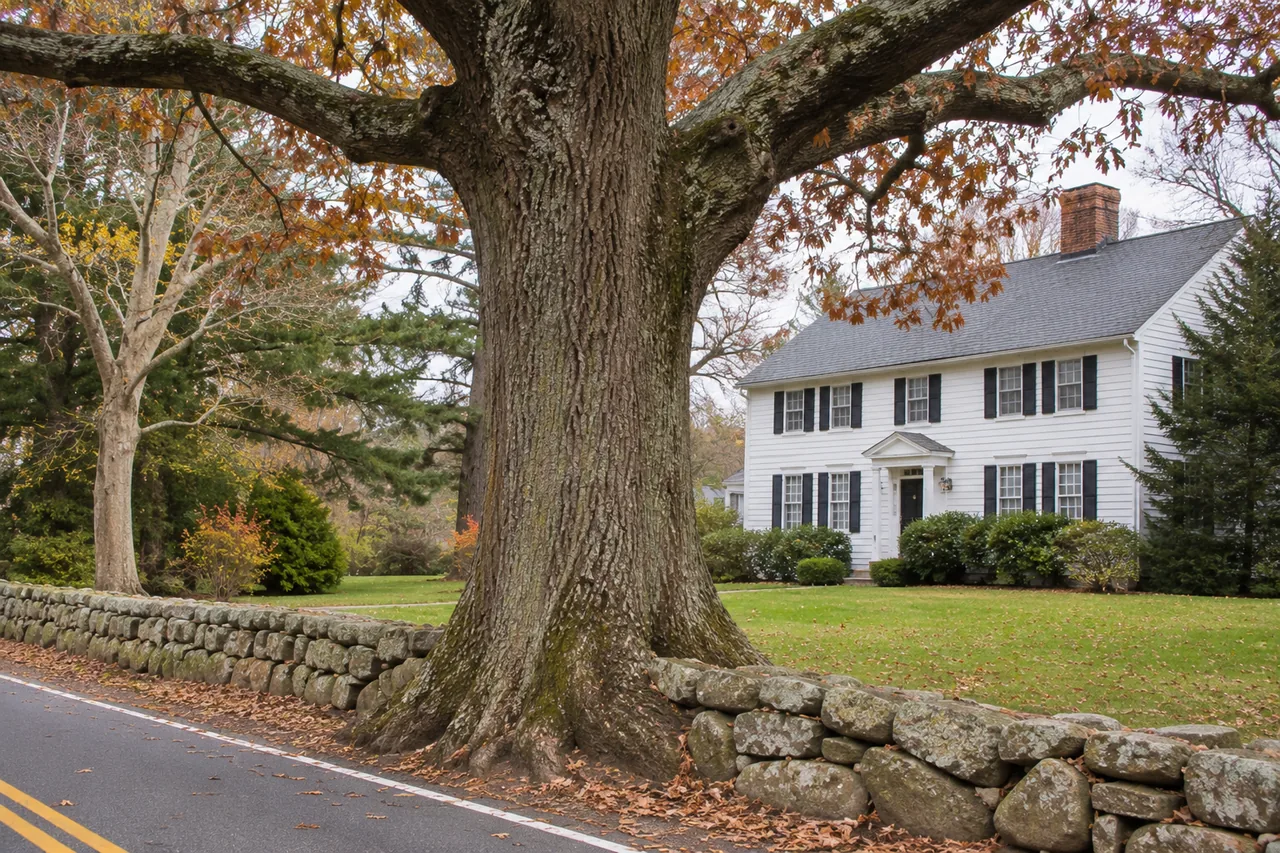
Which roads are the state's?
The numbered routes. CT DEEP's guide puts trees along state roads, the roads with a route number, under the Department of Transportation; a town can care for them only with DOT's permission, and "The State retains final authority over these trees." Anyone planting, pruning or removing one needs a DOT encroachment permit first (CT DEEP, checked Nov 28, 2026). In Branford, that includes US Route 1 and Route 146, the shore road through Stony Creek, which is also a State Scenic Road (UConn Resilient Connecticut, 2019). Cutting or pruning vegetation within a scenic state highway without the state's permission can bring a town citation of up to $1,000 a tree (scenic road rules).
What about a tree on the property line or a neighbor's tree?
Connecticut has no single statute on boundary trees between two houses; most of it is case law. A report by the legislature's Office of Legislative Research summarized it this way (OLR Report 2020-R-0279, Oct 21, 2020):
- Branches and roots over the line: under a 1971 state Supreme Court case, a neighbor can cut them back up to the line, within limits.
- Cutting the neighbor's tree itself: CGS 52-560 makes whoever cuts trees on another's land without permission pay three times their reasonable value (five times for a tree meant to be sold as a Christmas tree), or only the reasonable value if the cutter honestly believed the tree was on their own land (CGS 52-560, checked Nov 28, 2026).
- A neighbor's tree falling on your property: the few recent trial court decisions found generally no liability between private owners for damage from a tree that falls naturally, even where the owner had been told it was decayed. They aren't binding, and no appellate court has ruled directly. Bills to make owners liable after written notice have not become law; the governor vetoed one in 2014.
None of that is legal advice. For a real dispute, a lawyer reads the facts. For a tree whose trunk sits right on the line, both owners usually have to agree before it comes down.
Whose job is the wire through the tree?
The pole-to-pole lines along the road are the utility's to keep clear. The service wire from the pole to the house is mostly the owner's. Eversource, in Branford and Guilford, says it removes branches between the pole and the house only when they are pressing on its service wire (Eversource, checked Nov 28, 2026). The power lines page has the details.
If it is the town's tree, what happens next?
Call the Tree Warden. If the tree is dangerous, the Tree Warden can order it removed or pruned for public safety at the town's cost; otherwise the town posts it 10 days ahead and a written objection brings a public hearing. If you want work done on a town tree yourself, for example pruning it back from your roof, you need the Tree Warden's written permit first, and the permit may require the stump removed or a new tree planted (permit rules).
Ownership questions people ask
The town tree in front of my house is dropping limbs on my car. What do I do?
Report it to the Tree Warden. The ordinance has the office investigate reported hazards and keep records of them, which also matters if a limb later does damage.
I want to plant a tree near the street. Do I need permission?
If the spot is within the road limits, yes: planting on town property needs the Tree Warden's permit. The Community Forest Commission also takes requests for trees planted on town land.
Can I remove a tree on my own lot that hangs over the road?
The parts over the road are town property under the ordinance, so call the Tree Warden before cutting. If the trunk is fully inside your line, the decision about the tree is yours, but limbs over the street still have to come down safely, often with the road closed or flagged.