Taking a tree down
Tree Removal in Branford, CT
Short answer
Tree removal in Branford, CT usually means a big oak, maple or pine taken down in pieces beside a house, lowered on ropes by a climber or cut from a bucket truck, with the wood chipped or cut into rounds and the stump left low or ground out. If the tree is wholly on your own lot and more than 100 feet from any wetland, stream or pond, no town permit is needed; if any part of it is in the town road or on town land, the Tree Warden decides.
One independent local contractor looks at the tree, the ground and the way in, then gives a price for the whole job.
Is the tree yours to take down?
Start here, because it decides who signs off. Under Connecticut law the tree warden has "care and control of all trees and shrubs in whole or in part within the limits of any public road or grounds" (CGS 23-59, checked Nov 28, 2026). Branford's Tree Ordinance repeats that and adds that anyone other than the Tree Warden or a deputy "must apply for and receive a written permit from the Tree Warden prior to conducting any such activity" on town property or in a public road (Branford Code Sec. 16-11(C), adopted Oct 9, 2019, rewritten Mar 8, 2023, checked Nov 28, 2026).
The road limits are often wider than the pavement. Branford defines a public road as town-owned streets and rights-of-way across their full width, so a maple between the sidewalk and your lawn, or an oak with half its trunk past the stone wall, may be the town's. Trees along numbered state routes such as Route 146 belong to the state Department of Transportation, which asks for an encroachment permit before anyone plants, prunes or removes one (CT DEEP, Who Manages that Tree?, checked Nov 28, 2026). The town tree page walks through how to tell.
What if the tree is near the marsh, a stream or a pond?
Then call the Inland Wetlands office before anything is cut. Branford's wetlands regulations list "clearing, cutting, alteration, damaging of vegetation (living or dead)" on land within 100 feet of the boundary of any wetland or watercourse as a regulated activity, and the agency can stretch that to the top of a steep slope (Sec. 2.1(qq), effective Aug 12, 2022, checked Nov 28, 2026). Ordinary upkeep of an existing yard may be allowed as a use incidental to the house (Sec. 4.1(c)), but the agency makes that call, not the homeowner. The office is at Town Hall, (203) 315-0675. The wetlands page has the details, including the tidal marsh, which is the state's.
How does a big tree come down beside a house?
It depends on what is underneath. The common ways around Branford:
- Felled whole. Only where there is open ground longer than the tree is tall and nothing in the way. On most shoreline lots there isn't.
- Climbed and lowered. A climber ties into the tree, cuts limbs and then sections of trunk, and a groundworker lowers each piece on a rope run through a pulley above the cut. Slow, but it fits a backyard with no truck access.
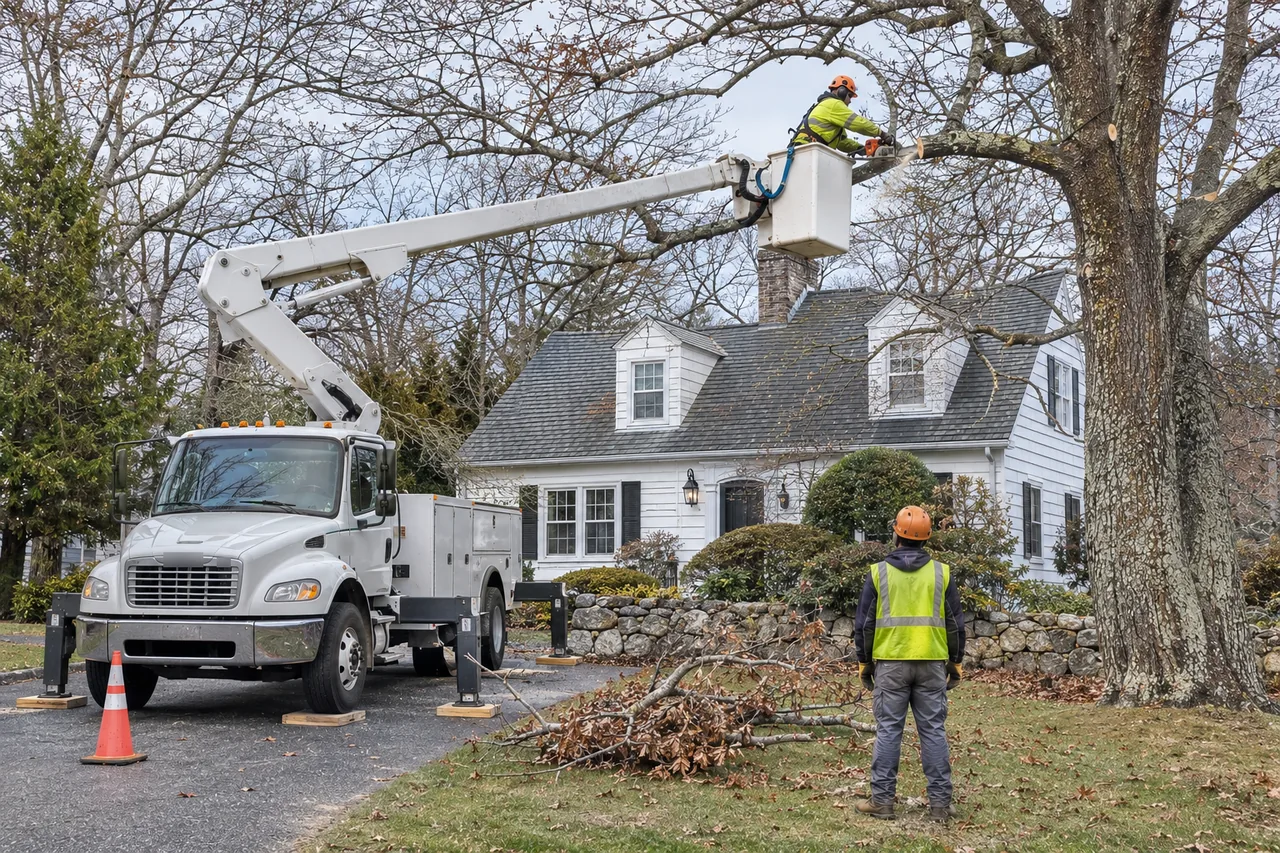
- From a bucket truck. Where the truck can reach, the operator cuts from the bucket and drops or lowers pieces. The truck needs firm, fairly level ground, with its outriggers set on pads.
- With a crane. For a large tree over a roof where nothing can be dropped, a crane lifts out whole sections. HomeAdvisor counts the crane at about $500 on the bill, and says complex crane jobs can reach $6,000 to $7,000 (HomeAdvisor, undated page, checked Nov 28, 2026).
Branford adds its own wrinkles. In Short Beach and Stony Creek, many lots are small and the streets narrow, so the chipper may sit well down the road. On ledge, outriggers may land on bare rock. Near the water, the ground can be soft for part of the year.
Which trees come down most often here?
Around Branford the big yard trees are mostly oaks, maples and white pines, with hickory, black birch, hemlock and beech in the wooded parts of town. The soil descriptions the federal soil survey uses for the area list several oaks, hickory and white pine as the common trees on Branford's outwash soils, and oaks, hickory, white pine, hemlock and birch on the thin soils over bedrock (USDA, Branford series and Hollis series, checked Nov 28, 2026).
The reasons people give for taking one down tend to repeat:
- A dead oak. After the spongy moth years and the 2015-2016 drought, oak deaths across Connecticut ran into 2018 and beyond. A UConn Extension forester's 2018 report on dead roadside trees warned that a dead oak starts dropping small branches soon, and that the trunk may stand three to five years before the roots rot and it topples (UConn, Tree Mortality in CT, 2018).
- Ash. Emerald ash borer has spread across the state since 2012; infested ash often die within two to three years (CT DEEP, checked Nov 28, 2026). Dead ash gets brittle fast, which is why crews prefer to take them before they are fully dead.
- Beech. Beech leaf disease, found in Connecticut in 2019, kills mature beech in six to ten years (CT DEEP, checked Nov 28, 2026).
- A lean toward the house after a storm, a split trunk, or roots lifting on one side.
- Too close. A pine planted next to the foundation forty years ago, or a maple whose roots are in the septic line.
The pests page covers the signs of each.
What about the wire to the house?
If the service line from the pole runs through the branches, it may need to come down while the work is done. Eversource, which serves Branford and Guilford, says it may temporarily remove pole-to-house lines for professional tree crews so they can prune or remove trees safely (Eversource, checked Nov 28, 2026). In North Branford and East Haven the utility is United Illuminating, which asks everyone to keep themselves and their equipment at least 10 feet from overhead lines (UI tree care brochure, checked Nov 28, 2026). Plan for the utility's schedule, not the other way around. More on the power lines page.
What happens to the wood and brush?
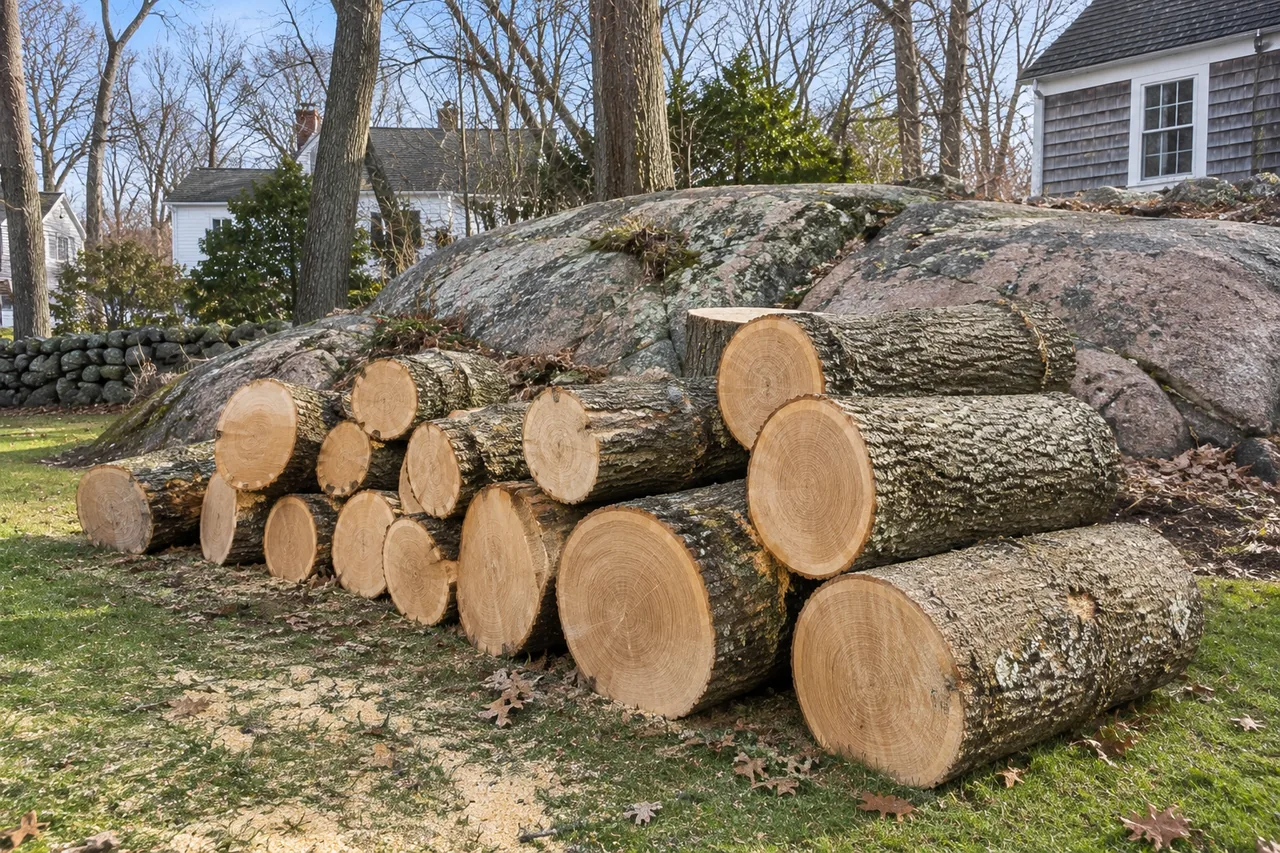
Most of it goes through the chipper. Trunk wood is usually cut into rounds and either hauled away or left stacked for firewood, which is worth settling before the work starts. Burning it in the yard is limited: Connecticut allows residential open burning only with a signed permit from the town's Open Burning Official, for brush no more than three inches across, between 10 a.m. and 5 p.m. on a sunny or partly sunny day, and never when the air quality index is forecast at 100 or higher anywhere in the state or the fire danger is high (CT DEEP, page updated Dec 10, 2021, checked Nov 28, 2026). Land clearing and leaves can't be burned at all. Ask the fire department's burning official before planning a fire in Branford.
What does removal cost?
HomeAdvisor's national figures by height: up to 30 feet, $150 to $450; 30 to 60 feet, $450 to $1,200; 60 to 80 feet, $800 to $1,500; over 80 feet, $1,000 to $2,000 (undated page, checked Nov 28, 2026). This Old House put the New Haven average at about $620, most jobs $302 to $1,328 (updated Feb 5, 2024, checked Nov 28, 2026). The full tables are on the cost page; the contractor's written price after seeing the tree is the one that counts.
What should be settled before the crew arrives?
- Whose tree it is, and whether the Tree Warden or the wetlands office has a say.
- Whether the stump gets ground, and how deep. On ledge, there may be a limit.
- What happens to the wood: hauled, chipped, or left as rounds.
- Where the truck parks, and whether a neighbor's driveway or the road shoulder is needed.
- Whether the wire has to come down, and who calls the utility.
The hiring guide covers what the written contract should say.
Removal questions people ask
Can the town make me remove a dead tree?
For town trees, the Tree Warden can order removal or pruning for public safety at the town's cost. For a tree on private land, Connecticut has no general rule forcing removal; the state's Office of Legislative Research has noted that bills tying liability to notice of a dangerous tree have not become law (OLR Report 2020-R-0279, Oct 21, 2020).
My neighbor's tree hangs over my roof. Can I cut it?
The OLR report notes that under Connecticut case law a neighbor can cut encroaching branches or roots back to the property line, within limits. Cutting down a tree that is on someone else's land without permission is another matter: CGS 52-560 sets damages at three times the tree's reasonable value (CGS 52-560, checked Nov 28, 2026).
Is winter a good time?
Often. With the leaves off, a climber can see the structure, frozen ground carries a truck better, and lawns and gardens suffer less. Storm season and the weeks after a big storm are the busiest.