
After a storm
Storm-Damaged Trees in Branford, CT
Short answer
After a storm in Branford, CT, a tree on a wire is the utility's problem first, a tree on the house or across the driveway is yours, and a tree in the town road is the Tree Warden's. Stay away from any wire, call Eversource in Branford and Guilford or UI in North Branford and East Haven if a line is involved, take photos for your homeowner's insurance claim, and then have the tree looked at.
One independent local contractor handles storm work in Branford, North Branford and Guilford: cutting the tree off the house, clearing the drive and dealing with what is left standing.
What should I do first when a tree comes down?
- Look for wires before you go near it. Treat every downed line as live. If the tree is touching a wire, keep everyone, pets included, well back and call the utility. UI asks people to keep themselves and their equipment at least 10 feet from overhead lines (UI, checked Nov 28, 2026).
- Get out if the house is hit hard. A trunk through the roof can shift as it settles. If you smell gas, leave and call from outside.
- Photograph everything from several angles, before anything is moved, for the homeowner's insurance claim.
- Cover what you can safely reach, such as a broken window, from inside.
- Call about the tree. A tree on the house usually comes first in a crew's line; a tree across the lawn can wait a day or two.
Generators and heaters kill people after storms here. After Irene and the October 2011 snowstorm, the state's Two Storm Panel counted thirteen fatalities and medical problems, most of them from carbon monoxide poisoning or misuse of backup generators and other heat sources (Two Storm Panel final report, 2012). Run a generator outdoors, away from windows, and never in a garage.
What have storms done to Branford's trees?
The shoreline gets every kind: tropical storms off the Sound, nor'easters, wet snow and summer microbursts. The recent record:
| When | Storm | What happened |
|---|---|---|
| Late August 2011 | Tropical Storm Irene | About 800,000 Connecticut customers lost power, some for up to nine days. Trees knocked down 90 percent of the wires that fell. |
| Oct 29-30, 2011 | Halloween nor'easter | Heavy, wet snow on trees still in leaf. A record 880,000 customers out statewide; full restoration took 12 days. |
| Oct 29, 2012 | Sandy | In Branford, 83 trees fell and 11 major roads closed; by Wednesday morning 75 percent of the town's CL&P customers were without power. Short Beach's Meadow Road substation flooded. Guilford was at 70 percent. |
| May 15, 2018 | Tornadoes and microbursts | An EF1 tornado ran 9.5 miles from Beacon Falls to Hamden at up to 110 mph, followed by a 100 mph microburst toward Wallingford. Two people died from falling trees in Fairfield County. |
| Aug 4, 2020 | Tropical Storm Isaias | About 8,800 trees fell onto power lines statewide: 7,500 breaks on Eversource's system and 1,336 on UI's. Outages peaked at 752,225; more than 600 roads were blocked; at least two people died. |
Sources: Two Storm Panel final report (Irene and October 2011); NWS Albany (Oct 2011 dates and snow); New Haven Independent (Sandy in Branford, 2012); Governor's disaster request, Jul 9, 2018; Governor's disaster request, Sept 30, 2020. Historical events.
Sandy is the one Branford remembers on the water. The New Haven Independent reported that a strong gust around 5 p.m. on the Monday knocked power out across town, police took more than 120 calls about downed trees and wires within minutes, a large tree fell on part of Rosenthal Gardens and residents were moved out, and Beckett Avenue in Short Beach, also underwater during Irene, took the worst damage. FEMA's major disaster declaration for Connecticut came on Oct 30, 2012, covering New Haven County among others (FEMA DR-4087).
Why did Isaias bring down so many healthy trees?
The state's utility regulator found that trees caused a disproportionate share of the outages, that many of them were healthy trees outside the utilities' rights-of-way, and that Isaias's winds blew from roughly the opposite direction of the region's usual winds, the direction trees had not "hardened" against (PURA Isaias ruling FAQ). The UConn and Eversource storm research center added that defoliation by gypsy moth in 2016, 2017 and 2018 and the 2016 drought had left trees across the state weakened, and that mid-summer trees carry their most leaves, so they catch the most wind (Eversource Energy Center, UConn, Aug 14, 2020).
Regulators later moved to fine Eversource $30 million, the most the law allowed, and UI more than $2.1 million over their storm response; some customers had been out up to nine days (Connecticut Public, May 7, 2021).
Why do trees here tip over roots and all?
Thin soil over rock. Across much of Branford, a tree's roots spread wide through a foot or two of stony till over ledge instead of going deep, so in a soaking storm with wind, the whole root plate can lever up, carrying a slab of soil and stones with it and leaving a hole where it stood. Near the marsh and on wet ground, saturated soil lets go the same way.
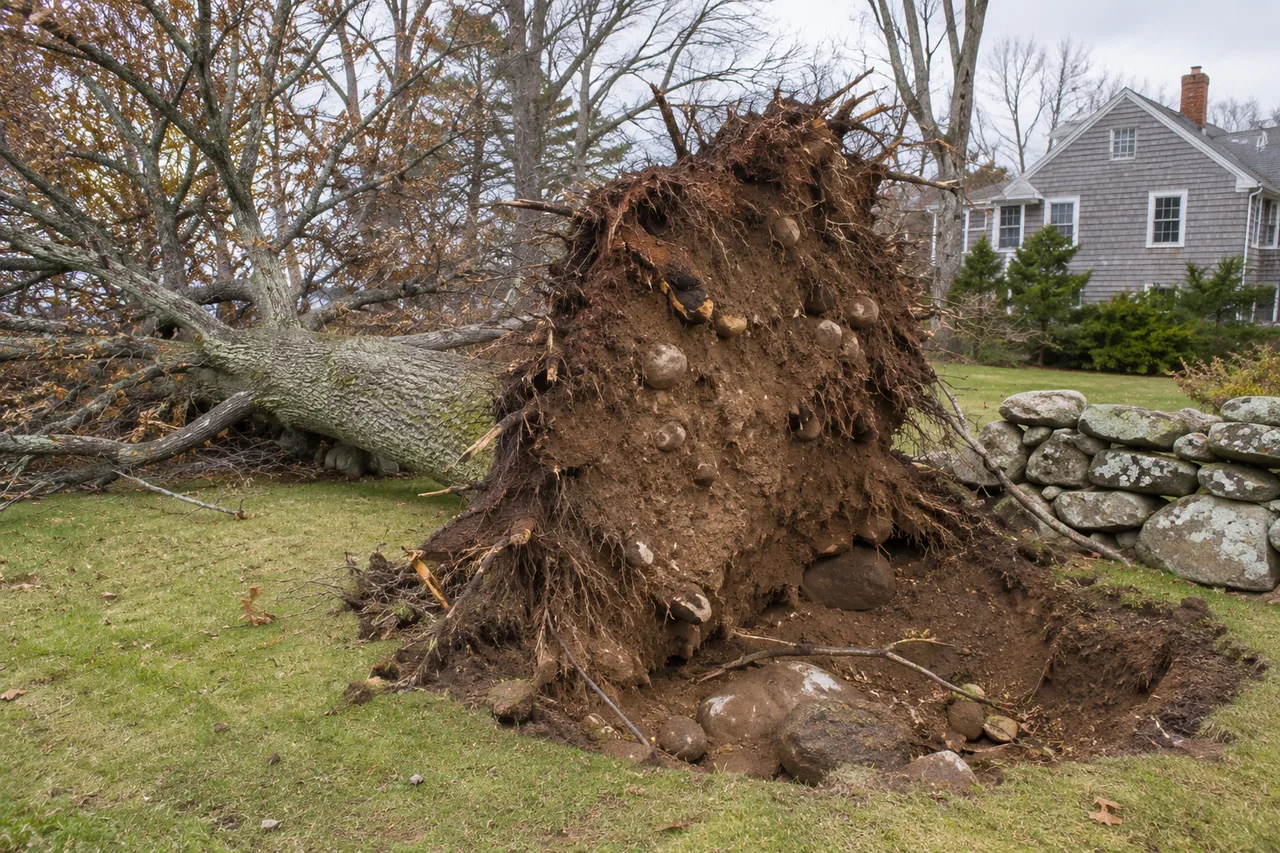
A tree that is leaning after a storm, with the soil cracked or heaved on the side away from the lean, may have broken roots and can fall without more wind. Keep people out from under it and have it looked at soon.
Who clears a fallen tree?
- A tree on a wire: the utility makes the line safe first. Tree crews won't touch a tree on an energized line.
- A town tree in the road: the town, through the Tree Warden and Public Works. In Branford, call (203) 488-4156; after hours, call the police non-emergency line.
- A state road such as Route 146 or Route 1: the state Department of Transportation.
- A tree from your own yard, or a neighbor's tree that fell on your property: the owners and their homeowner's insurance. The state's Office of Legislative Research has noted that Connecticut courts have generally not held one private owner liable to another for a tree that falls naturally, even after notice, and that bills to change that have not passed (OLR Report 2020-R-0279, Oct 21, 2020). Check your own policy.
What does storm work cost?
More than a planned removal. HomeAdvisor says emergency removals can run as high as $5,000 and that rates rise after big storms when crews are in demand (HomeAdvisor, undated page, checked Nov 28, 2026). This Old House put an emergency removal around New Haven at about $1,594 (updated Feb 5, 2024, checked Nov 28, 2026). A crane over a roof adds cost. Ask for the price in writing, and keep receipts for the insurance claim. See the cost page.
What can be done before the next storm?
- Have the big trees nearest the house looked at, especially oaks with dead tops, ash and beech.
- Take out deadwood over the roof and driveway.
- Deal with a split fork on a maple before wet snow does.
- Know who your utility is and keep its outage number handy.
Storm questions people ask
Will my homeowner's insurance pay for tree removal?
It depends on the policy and on whether the tree hit something covered, like the house or a fence. Many policies treat a tree that fell on open lawn differently from one on the roof. Call the insurer or agent and read the policy.
A town tree fell on my car. Who do I call?
The Tree Warden at Public Works and the police for the report, then your own insurer.
How fast can a crew come?
After a widespread storm, crews line up jobs by danger: trees on houses and blocking driveways first. The contractor will tell you when on the phone.