Keeping the tree
Tree Trimming in Branford, CT
Short answer
Tree trimming in Branford, CT is mostly taking dead wood out of big oaks and maples, lifting limbs off roofs and driveways, and thinning a crown so wind passes through it, without cutting so much that the tree suffers. Branford's Tree Ordinance bans topping, and its pruning standards say no more than 25 percent of a tree's leaves should come off in one trimming; that is good practice for your own trees too.
One independent local contractor looks at the tree, says what should come off and what should stay, and prices the job.
What does a pruning job usually include?
Most requests in shoreline towns fall into a few kinds of work:
- Deadwooding. Taking out dead and dying branches, the ones most likely to drop in the next nor'easter. On older red and black oaks, this is the most common job by far.
- Clearing the house. Cutting back limbs that rest on shingles, scrape gutters, or hang over a chimney, so leaves and twigs stop piling up and storms have less to throw at the roof.
- Raising the crown. Removing low limbs over a driveway, sidewalk or the street, so a car, a delivery truck or a plow can get through.
- Thinning. Taking selected branches out of a dense crown to let light and wind through, rather than shortening everything.
- Storm repair. Cleaning up torn limbs back to a proper cut after a storm, so the wound can close.
Why is topping banned in Branford?
Because it ruins trees. The ordinance's pruning standards say limbs "are to be pruned to branch collar and topping of trees is not permitted," and define topping as "the severe cutting back of limbs to stubs larger than three inches in diameter" in a way that removes the tree's normal canopy (Branford Code Sec. 16-12(C)(3), adopted Oct 9, 2019, rewritten Mar 8, 2023, checked Nov 28, 2026). The same section adds, "Per ANSI pruning standards, no more than 25% of a tree's foliage should be removed per trimming," and discourages ground-to-sky clearing for lines.
Those standards sit in the section on utility pruning of town trees, so they bind utility work on trees the Tree Warden controls. On a tree in your own yard, nobody fines you for topping it. But the reasons hold: big stubs rot, a topped tree sends up dense, weakly attached sprouts that break in the next storm, and taking off more than a quarter of the leaves at once starves the roots. If someone offers to "top" a tall oak to make it safer, the result is usually the opposite.
What is a cut to the branch collar?
The collar is the slightly swollen ring of bark where a branch joins the trunk or a larger limb. A cut just outside it, not flush with the trunk and not leaving a stub, lets the tree seal the wound. Heavy limbs are taken off in steps: an undercut first, then a cut from the top a little farther out so the weight drops without tearing bark down the trunk, then the final cut at the collar.
Does each kind of tree get pruned differently?
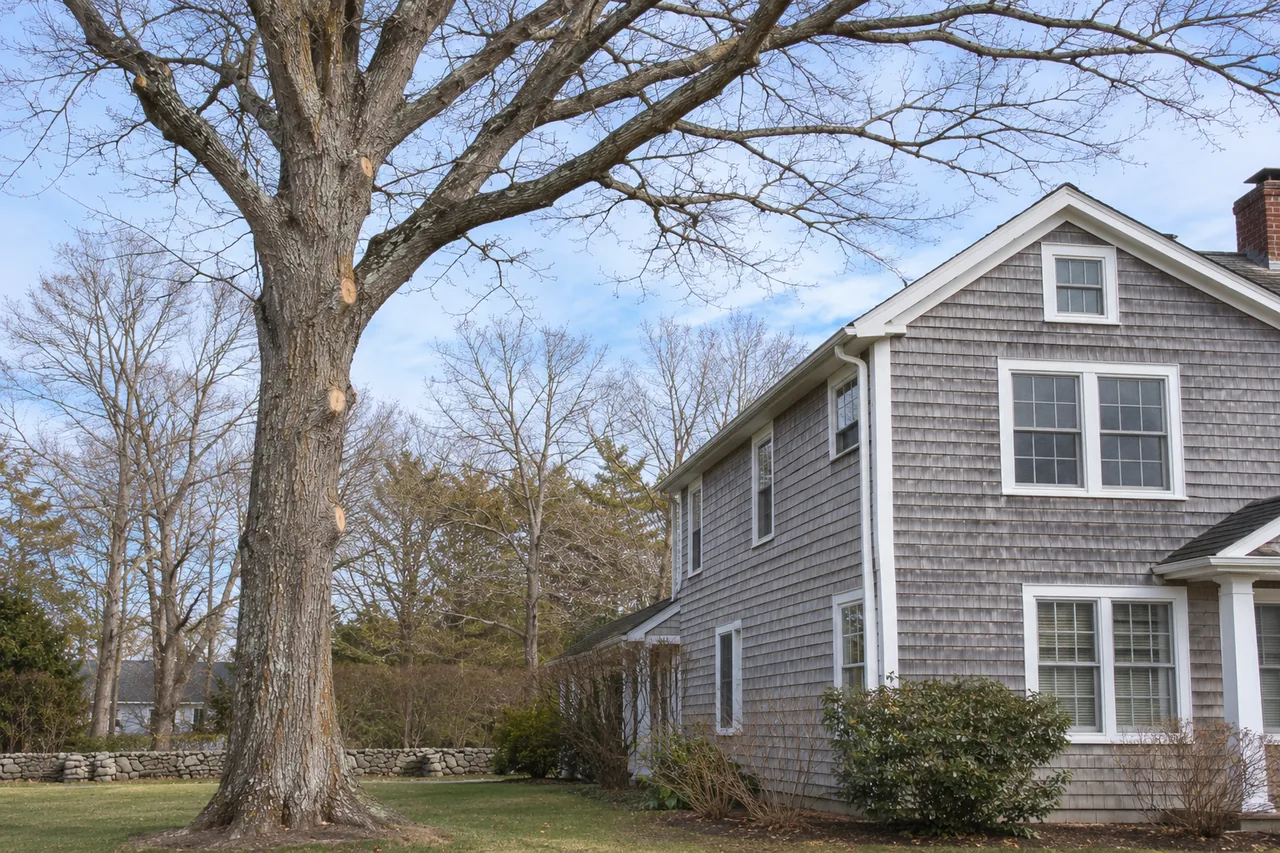
- Red and black oaks carry heavy horizontal limbs and a lot of deadwood as they age. Deadwooding and reducing the end weight of long limbs over a roof are the usual work.
- Sugar, red and Norway maples often grow tight forks with bark squeezed between the stems, a weak joint that splits in wind or under wet snow. A crew may cable a fork or remove one stem early.
- White pines shed lower limbs on their own and break high in ice and wet snow. Pruning is mostly removing broken tops and dead lower branches.
- Hemlocks and beech on wooded lots may be under attack by hemlock woolly adelgid or beech leaf disease. Pruning can't fix either; see the pests page before spending money on a tree that may be in decline.
When is the best time to prune?
Late fall through winter, with the leaves off, is when a climber can see every branch and the tree is dormant. Dead wood can come out any time of year. The October 29-30, 2011 snowstorm showed why fall matters: heavy, wet snow landed on trees still in full leaf, and outages were worst and longest where the leaves were still on (NWS Albany, checked Nov 28, 2026). Statewide, a record 880,000 customers lost power and restoration took 12 days (Two Storm Panel report, 2012).
Can I trim my neighbor's branches over my yard?
Within limits. A report from the legislature's Office of Legislative Research notes that under Connecticut case law, a neighbor whose property is encroached on can cut back branches or roots to the property line (OLR Report 2020-R-0279, Oct 21, 2020). That doesn't extend to killing the tree or going onto the neighbor's land without permission, and cutting someone else's tree down carries damages of three times its value under CGS 52-560 (checked Nov 28, 2026). Talking to the neighbor first saves a lot of trouble. If the branches come from a tree in the town road, they are the Tree Warden's.
What does state law say about tree care done for hire?
Connecticut defines "arboriculture" as "any work done for hire to improve the condition of fruit, shade or ornamental trees," including pruning, bracing, feeding, cavity work and protection from insects and disease, and regulates that work under CGS 23-61a and 23-61b through the State Tree Protection Examining Board at DEEP (CGS Chapter 451, checked Nov 28, 2026). Owners may care for trees on their own property. For a town tree, the town may require permitted pruning to be supervised as state law provides; the Tree Warden's permit will say.
What about limbs near the power lines?
Lines on the poles belong to the utility, and so does trimming near them. Eversource's scheduled trimming clears 8 feet to the sides of its lines, 10 feet below and 15 feet above, on a four- to seven-year cycle (Eversource, checked Nov 28, 2026). The wire to your house is mostly yours to keep clear. The power lines page sorts out who does what.
What does trimming cost?
| Tree height | HomeGuide | LawnStarter |
|---|---|---|
| Up to 30 feet | $250 to $700 | $85 to $415 |
| 30 to 60 feet | $600 to $1,200 | $215 to $790 |
| Over 60 feet | $1,000 to $2,500 or more | $475 to $1,835 |
| Typical tree | $400 to $900, about $650 average | $430 to $640 |
Sources: HomeGuide (undated, checked Nov 28, 2026); LawnStarter (updated Sept 24, 2026, checked Nov 28, 2026). National figures, not Branford prices.
Big oaks over roofs, a crown that needs a climber rather than a bucket, and storm work all push toward the top of those ranges. The contractor's written price after seeing the tree is the real number. See the cost page for removal and stump figures.
Pruning questions people ask
How often should a big oak be pruned?
There is no fixed schedule. A mature oak near a house is often checked every few years and deadwooded as needed. A tree that dropped limbs in the last storm is due now.
Will pruning save a tree with beech leaf disease or ash borer?
No. Pruning removes the dead parts but doesn't stop either problem. Treatments exist for single valuable trees; for an ash already losing its crown, removal is usually the safer plan.
Can the town trim a tree in my front yard?
If any part of the tree is within the town road limits, yes: the Tree Warden controls it, and non-emergency pruning gets posted on the tree at least 10 days ahead, with a hearing if someone objects in writing (Branford Tree Ordinance, Sec. 16-10(C)).