Utility lines
Trees and Power Lines in Branford, CT
Short answer
In Branford, CT, Eversource trims trees along its pole-to-pole lines on a four- to seven-year cycle, while the service wire from the pole to your house is mostly the owner's to keep clear; Eversource takes branches off that wire only when they press on it, and can take the line down for a tree crew. North Branford and East Haven are on United Illuminating, which keeps an 8-foot zone around its lines, and UI asks everyone to keep themselves and their equipment at least 10 feet from overhead lines.
One independent local contractor handles the private-side work, coordinating with the utility when the wire has to come down.
Which utility serves my street?
It splits right at Branford's town lines. United Illuminating's service area is 17 towns, including East Haven and North Branford, but not Branford or Guilford (UI service area, checked Nov 28, 2026). Branford and Guilford are Eversource, the company that was Connecticut Light and Power at the time of Irene and Sandy.
| Utility | Towns here | Tree questions |
|---|---|---|
| Eversource | Branford, Guilford | 800-286-2000 (residential); TreeCT@eversource.com; tree trimming line 844-275-3302 |
| United Illuminating | North Branford, East Haven | Vegetation management 866-829-4461; trees@uinet.com |
Sources: Eversource tree information on Branford's town site; UI tree care brochure; tree trimming phone lines required by PURA, as listed by the CT House Democrats (undated). Checked Nov 28, 2026.
What does Eversource trim?
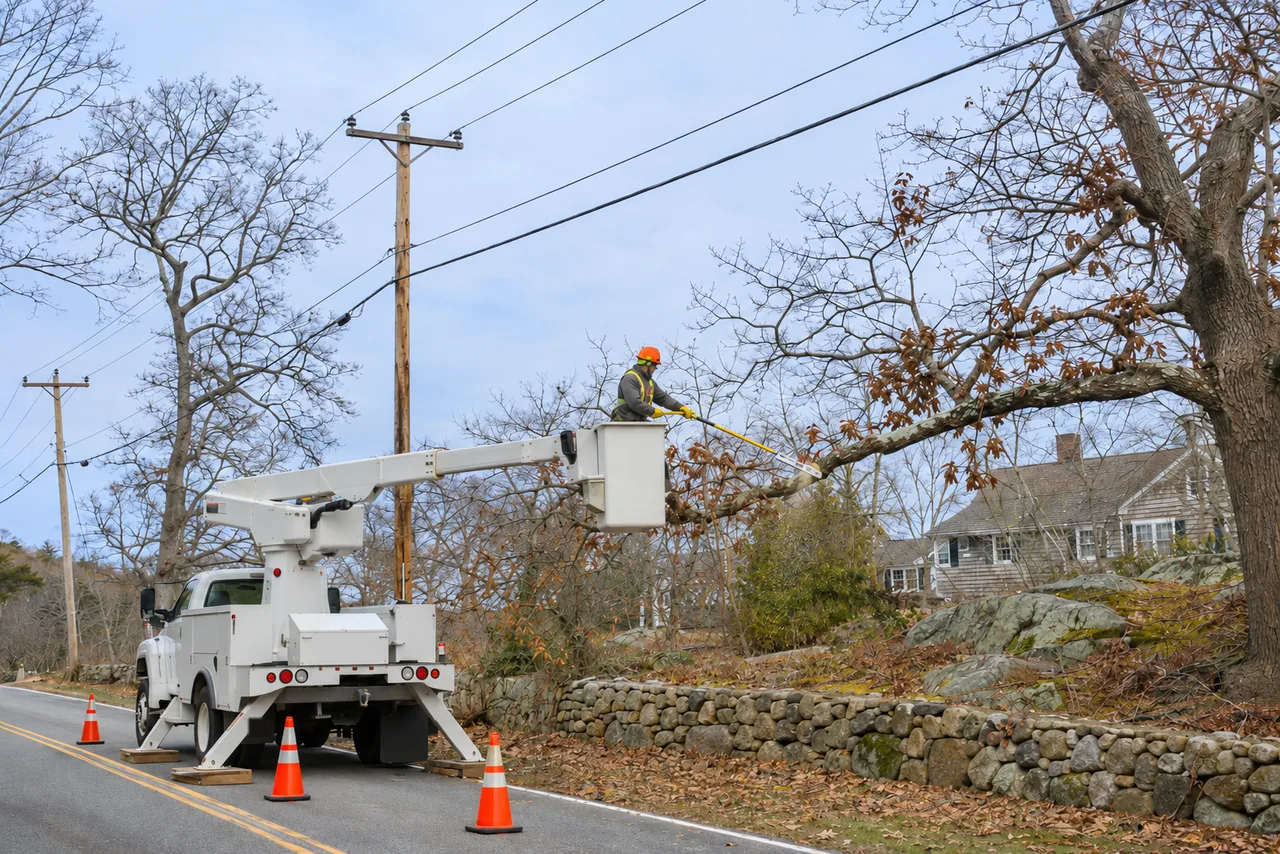
Its own distribution lines along the road, on a schedule. Eversource says its scheduled maintenance trimming clears "eight feet on sides, 10 below, and 15 feet above the line," that its Enhanced Tree Trimming goes to 8 feet on the sides, 10 feet below and at least 20 feet above, and that crews prune on a four- to seven-year cycle (Eversource tree trimming FAQ, checked Nov 28, 2026; the page doesn't say which state it covers). Between the pole and the house, Eversource removes branches only when trees or branches are applying pressure to its service wires, and it may temporarily take pole-to-house lines down for professional tree crews so they can prune or remove trees safely.
What does UI trim?
UI manages trees around its lines to keep a Utility Protection Zone that "extends 8 feet horizontally from the pole-to-pole electrical wire from ground to sky." Limbs growing into the zone may be removed at the main branching point, or at the trunk if necessary. Privately owned trees "will not be pruned or removed without the owner's consent, except when they're in contact with power lines or show signs of burning" (UI tree care brochure, checked Nov 28, 2026). UI's advice for everyone else: keep yourself and your equipment at least 10 feet from overhead lines.
Can a utility cut a town tree?
Only with permission and to the town's standards. Connecticut requires written permission before anyone, a utility included, cuts or removes a public shade tree; if a utility's request is turned down, the appeal goes to the Public Utilities Regulatory Authority within ten days, and the utility has to prove public convenience and necessity require the cutting (CGS 23-65(f), checked Nov 28, 2026). Branford's Tree Ordinance has the Tree Warden review utility work affecting trees, and its utility maintenance section requires pruning to the branch collar, bans topping, points to the ANSI limit of 25 percent of foliage per trimming and discourages ground-to-sky clearing (Sec. 16-12(C)(3), rewritten Mar 8, 2023, checked Nov 28, 2026). On the Route 146 scenic road, a utility pruning to protect its lines is not cited under Branford's scenic road article.
Who clears the wire to my house?
Mostly you, the owner. Eversource's own guide for new service says that "Tree trimming on private property, if necessary, is also the responsibility of the customer" (Eversource CT process guide, checked Nov 28, 2026). In practice:
- If limbs are lying on or pressing the service wire, call the utility; that's the case Eversource says it handles.
- If the wire runs through a tree you want pruned or removed, arrange for the utility to take the line down for the day. Tree crews coordinate that, and the timing depends on the utility.
- Never prune near the wire yourself with a pole saw or ladder. Contact with a live line can kill.
Why do the lines go down so often here?
Trees. After Irene, the state's Two Storm Panel found trees had knocked down 90 percent of the utility wires that fell, and warned that while Irene downed about 1 to 2 percent of the state's trees, a major hurricane could down 70 to 80 percent (Two Storm Panel final report, 2012). In Isaias, about 8,800 trees fell onto lines (Governor's disaster request, Sept 30, 2020), and PURA found that many were healthy trees outside the rights-of-way, saying it was "increasingly unclear" what benefits trimming programs provide against storms (PURA Isaias FAQ). The tree most likely to take out your power may be in your own yard.
What should be planted under the wires?
Something small. UI's guidance: low trees that mature at up to 25 feet can go near roadside lines; medium trees of 20 to 45 feet should stand 15 to 30 feet away; large trees of 45 feet or more at least 30 feet away (UI). Before digging a planting hole, call 811; Connecticut requires a Call Before You Dig request two full working days ahead when power equipment is used (PURA).
Power line questions people ask
A tree is leaning on the wire to my house. Who do I call?
The utility: Eversource in Branford and Guilford, UI in North Branford and East Haven. Keep away from the wire and the tree.
Can I make the utility take down a tree that keeps hitting the line?
You can ask; the utility decides about its own lines. For a town tree, also call the Tree Warden. For a tree on your property, you can have it removed at your cost, with the line dropped for the work.
The utility marked trees on my street for cutting. Can I object?
If they are town trees, removal goes through the Tree Warden's posting and hearing process, and a written objection triggers a public hearing (posting and hearings).